Welcome to Hey Virgil 1.1!


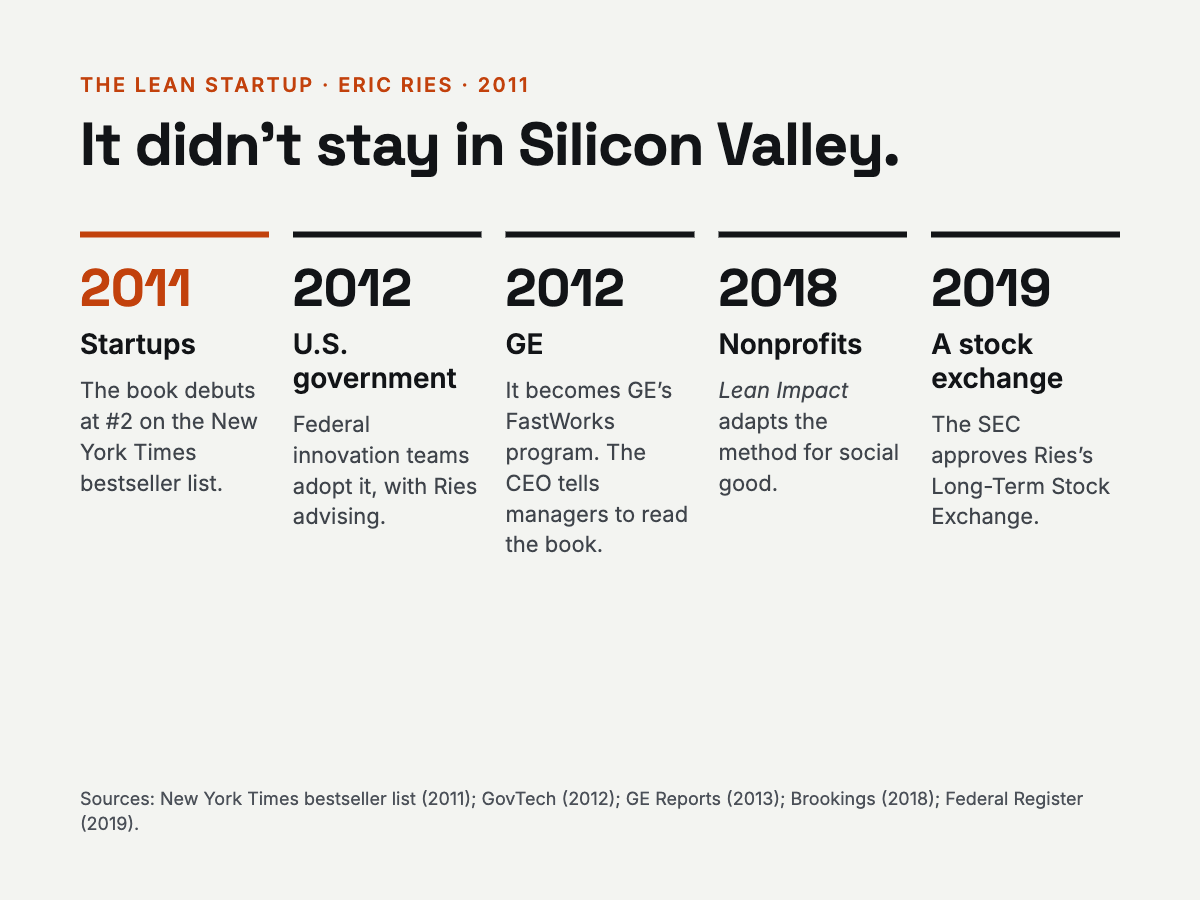
I first came into tech in the early 2010s, which is when everybody who was anybody in it was reading The Lean Startup by Eric Ries [2]. I don’t know if you can measure its impact, so I asked the 🤖 to try.
Here’s what Claude came up with:
Then I asked Gemini:
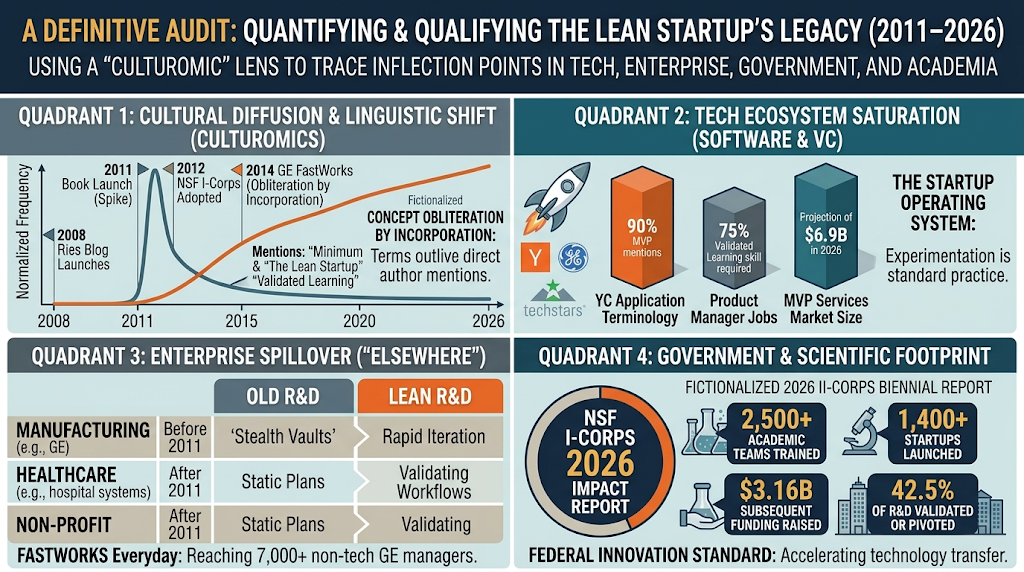
They DO agree—and me too—that the book gave us several concepts that massively shape product today. The ones I care about for this post are:
- Build–Measure–Learn loop: ship something small, measure real behavior, learn, repeat. The goal is to get around the loop faster.
- MVP (minimum viable product): the smallest thing that tests your riskiest assumption. It isn’t a smaller version of the final product.
- Validated learning: proving empirically that a business model is viable, rather than relying on "vanity metrics" (like total downloads or raw pageviews) that look good on paper but mask a lack of real traction.
- Pivot or Persevere: Using structured checkpoints to decide whether to double down on the current strategy or make a fundamental change in direction while keeping the overarching vision intact.
In my own little history, my mentor Jaime Levy [3] transformed her entire practice around them, and so they are the bedrock on which all my formal product learning is built.
And that's what you’re seeing right now with this publication! I’ve learned a few things about you all and us from the last few posts, and so I’m ready for a pivot!
So here we go!

Let’s now talk about my 5-month sabbatical.
I’ve taken one before—more than a decade ago—in which I traveled through 10-ish (🤔💭🤷♀️) countries, didn’t complete anything, ate a lot of pastries, saw a lot of modern art, came back, and launched my indie consulting business [4].
This time, I didn’t go to Europe. I barely left my neighborhood. Mostly, I just made space for myself to think deeply about what I care about, my art, my work, my business, and what I’d like to make for myself and others in the future. I just felt like it was time to answer some questions that have befuddled me for the last few years. They’re the questions that brought Jon and I to each other, and it’s how we’ll re-focus this publication for the present. Because they are what are fueling our pivots.
- What do we want to build? We both have about two decades of product building under our belts. And we both agree that tech is too skewed toward businesses, investors, and large technology. The simple promise of the early 1990s—personal tech for the individual—is getting lost in all the noise. So Jon and I are asking ourselves: How might we create tech that helps people feel more agentic instead of less?
- What if we build creatively first then with tech? When Jon and I build for businesses, there’s a lot that we don’t get to create. Businesses demand revenue, optimization, efficiency, and automation. Often, you are given the vision, and the adventure is building through the wilderness to make it real. But as the company grows, then teams, customers, partners, and communities get sidelined in favor of larger profit. Experiences that were built around a human painpoint get erased by feature bloat and pivot to the more lucrative business painpoint. The individual wants the human solution, but the VP of Business needs to make their quarterly numbers go up. An interface that once made life convenient now atrophies behind a locked door, and the space to experiment becomes smaller. But what about the humans? Humans like play, exploration, and discovery. Humans like to figure out problems, change how they do things, evolve into different people, and adapt to novel situations. Unlike businesses, we are not looking to live in systems and use tools that help us grow into massive conglomerations with total marketshare. So how might we create environments that help us feel more imaginative and human? With technology? And over the course of our lives where what we need technology to do for us also changes?
- What is AI fluency—really? For most of my adult life, I’ve adapted to a new technology—AOL, smartphones, cloud sharing, etc.—or learned a new software—Photoshop, Sketch, Figma, etc. But LLMs are a real doozy. Unlike everything previously, you the person really need to understand what the technology does for you—to delegate, optimize, collaborate, or avoid. I’m still 50/50 on it honestly. But one thing I can say is that the tech is massively powerful. In the 2010s, Ries’ book described a framework that would de-risk investing in a prototype before building it because the cost was A LOT. But Artificial Intelligence throws that out the window; building the thing now costs absolutely nothing. Which means if the individual is empowered with understanding, purpose, and imagination, they can feasibly build the thing no matter what how complicated it is! So then, what IS IT that’s worth building for ourselves and others? And if we’re going to build it, how does it give us more freedom rather than less?
- How do we change the landscape? Whenever I’ve been lost, I try to get more creative instead of less. Whenever I’ve been confused, I try to become more collaborative instead of less. Whenever I’m not sure where to go, I try to curiously explore many paths before choosing one. That’s the artist in me. The artist really knows how to tackle uncertain spaces. The consultant in me knows how to get people to make grounded decisions that serve everyone. And the product maker knows what to build once the decisions get made.
But what answers did you get, Sarah
I’m not sure but here’s what I can tell you and what Jon and I are still exploring in our weekly collaborations:
- How to recenter our use of technology around creativity and imagination—For example, like this post, Jon and I used the poetry technique of erasure instead of just building an app with AI. We’ve also experimented on other people. We’ll share in future posts.
- The gap between artistry and entrepreneurship is the width between two sides of the same coin—I always knew it. But now that I’m trying to be an entrepreneur, I see how the skills are pretty much the same. In fact, in a recent Manual Override guest talk, Milly Tamati said that entrepreneurship is emergent. And when Jon and I first started collaborating, that’s what I told him I missed the most—the excitement of not really knowing what I'm building—yet. There was no room for the unexpected. I don’t think that anymore. I have no idea what this publication will be in 4 weeks let alone 4 years!
- How Jon and I are building products are changing—with and without technology. The whole techstack, process, and methodology is different, and we’ll share it here.
- What are future business models for tech? The cornerstore of any business is the business model, which is the engine that makes revenue from products and services. For the last 20 years, tech has dug deeply into one. But we both believe human connection and imagination will play a key role in the future, so we are experimenting on models that believe in partnership and collaboration.
- Sooooo many people are wrestling with these things! And we are talking to them! And inspired by them! We’ll share!
- Changing the landscape is a daily decision and daily practice. Like this post and pivot.
And then to close, please tell us! Are you thinking these things to? Have you learned something important?!?!?! We want to know!
The pivot that keeps giving! (Master Prompt)
Gemini's Master Prompt:
"Reimagine [INSERT FAMOUS PAINTING OR POP CULTURE SCENE] as an intricate oil-on-masonite painting in the exact surrealist style of Remedios Varo. Keep the recognizable composition and key props of the original scene, but translate the subjects into androgynous, heart-faced alchemists and mystics with elongated proportions, delicate features, and contemplative expressions. Integrate clockwork mechanisms, brass gears, glowing distillation flasks, celestial charts, and translucent silk threads into their clothing and objects. Set the scene inside a narrow, impossible Gothic tower with spiral staircases, arched windows opening onto starry skies, tethered crescent moons, and misty, decalcomania-textured landscapes. Render with luminous, jewel-toned glazes in burnt sienna, antique gold, deep teal, and smoky amber, combining razor-sharp architectural drafting with organic, mossy wall textures."
References
[1] Remedios Varo, Wikipedia
[2] The Lean Startup, Wikipedia
[3] Jaime Levy, Wikipedia
[4] Sarah Strategic, main site